Places
Unpacking The Lazy Qatari Stereotype
How a colonial smear campaign rewired the perceptions of local populations
If you’ve ever had your qatariness questioned after doing something that requires effort; congratulations! You were the victim of the Lazy Qatari stereotype. I’ll never forget every time someone questioned my qatariness during undergrad. I never liked that question because I knew that it almost always came from a place of disbelief and skepticism. Nothing about the way I dressed or my name was spelled gave “foreign,” but apparently my work ethic did. I couldn’t seem to put my finger on it. Why is it that whenever someone in an abaya or a thobe is excelling at what they do, they are suddenly not representative of their people? And why is laziness attributed to Qataris?
The Lazy Native
The lazy native is not a new concept. In his book “the myth of the lazy native,” Malaysian sociologist Syed Alatas wrote about the stereotype of the lazy native perpetrated by european colonizers in south asia. The lazy native is unambitious, unproductive and refuses to progress. These colonial powers used this stereotype as an ideological tool to justify the control of power and land seizure in those areas. They framed the locals’ refusal of hard labor in mines and docks as “backwardness” rather than what it truly was: a refusal of exploitation by foreign abusers. The myth of the lazy native eventually succeeded in pounding down the locals’ images of themselves and the internalization of this inferiority complex within the native population of these colonized communities.
This concept introduced by Alatas is not unique to south asian communities. Rather, his work helps us see the way these stereotypes are perpetuated by colonizers in other global south communities. In the case of Qatar, and the GCC countries at large, British officials in the gulf often portrayed the native tribes and bedouins as idle or resistant to modernization, and actively dismissed the harsh realities of the almost non-existent economic systems and the difficulties of their livelihoods in the dry and arid Arabian peninsula.
Today, in the post-oil era, this discourse resurfaced in a new form: Qatari natives are spoiled, privileged, have no incentive to work or provide (since they will be provided to, regardless) and barely put in any effort in their job. They are often contrasted with the supposedly hardworking migrant labor force. This narrative is problematic for many reasons. It mainly shifts attention away from the structural conditions of labor markets, rapid economic change and the political economy of migration, and instead attributes economic patterns to cultural flaws. Moreover, the lazy qatari stereotype is really problematic because it is built upon the belief that English is the main language at work. Many Qataris don’t speak English as their first language (Arabic is their native language) and contrary to what many may believe, not speaking English doesn’t make anyone stupid. Another misconception is that since Qatar has a thriving economy and people have stable incomes, locals don’t have to work. This claim makes absolutely no sense, as a system supported entirely by foreigners would never yield such results. Locals still work hard to provide for themselves and their families, and struggle isn’t the only way to be efficient at work.
I personally blame the work and corporate culture today that are shaped by Western, neoliberal systems and beliefs for the continuation of the lazy qatari stereotype. One cannot deny that western work culture clashes with Qatari and Muslim cultural practices. This foreign system expects a level of commitment that sometimes requires sacrificing social life, which is a huge part of Qatari culture. Just because Qataris aren’t willing to bend over backward for an eight-hour shift doesn’t make them lazy.
The harsh truth is that the Qatari system produces highly efficient workers who don’t have to struggle to get where they are, unlike in many other societies where corruption or hardship is part of the climb. This is exactly why Westerners and foreigners often label them as lazy or inefficient. Sadly, many Qataris have started to internalize this narrative, even though trying to fight it by overcompensating won’t help.
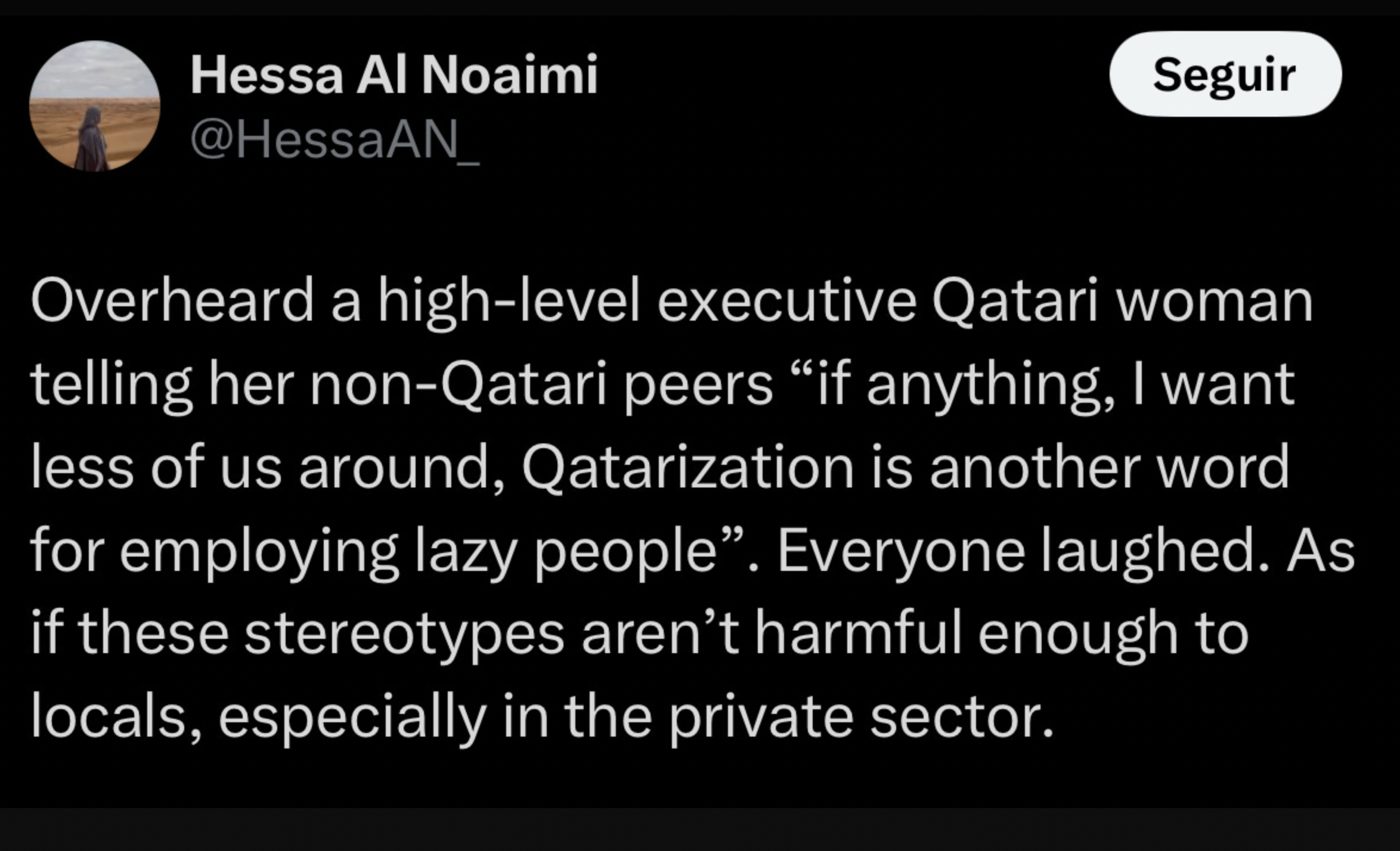
This is by no means an article that aims to pit two groups of people against each other; anyone can be guilty of perpetuating the Lazy Qatari stereotype. I came across the tweet below about two years ago while scrolling on twitter. I am still disgusted by the statements made, and I cannot deny that such parasites exist amongst us. While chatting with my sister, one of the most hard-working people I know, she shared the following insights: Qataris are offered numerous benefits and privileges, and it is important for them to take full advantage of these opportunities. She noted that while some locals might choose a more leisurely path, there are many incentives for striving toward excellence. She believes that any Qataris who feel a strong sense of responsibility to excel and take on leadership roles, should not shy away from these opportunities. She also emphasized the broader impact of motivation, suggesting that a knowledge-based economy cannot thrive if the stereotype of the “lazy Qatari” persists.
Media representations of the “Lazy Qatari”
The lazy qatari stereotype does not only exist in people’s minds and actions, there even exist media representations of it. Faiz al tuosh is a comedy series produced from the late 80s to the early 2000s in Qatar. The show served as a social commentary and tackled topics that were largely considered taboo by Qatari society. In one of their most famous episodes, Faiz helps his neighbor, a document holder portrayed by Abdulnasser Darwish, in getting his Qatari citizenship. After securing his passport, his character begins to wreak havoc in society. He starts making racist statements, sells his house to buy a land cruiser and a falcon, and even changes his dialect to a bedouin dialect. To this character, his qatarization meant he can now be irresponsible, reckless and imprudent. Another character that is used to reference the Lazy Qatari stereotype is one that is portrayed by the late actor Abdulaziz Jassim in the 2007 comedy series Al-Maqarid. This character is constantly referenced by saying “I’m a citizen, I don’t have to work” embodying the Lazy Qatari stereotype.
The myth of the lazy native reveals how colonial and postcolonial discourses have systematically misrepresented the work and agency of local populations to justify economic and ideological control and domination. Its persistence in contexts such as Qatar’s demonstrates that these stereotypes can adapt to different contexts and take on different forms. By framing nationals as inherently unwilling to work, this discourse overlooks the realities of globalization, development, the structure of institutions and organizations, and historical contexts, thereby perpetuating a narrative that serves corrupt interests. Recognizing and challenging these myths is essential to understanding both the historical and contemporary dynamics of work, culture and identity in ideologically colonized and postcolonial societies.